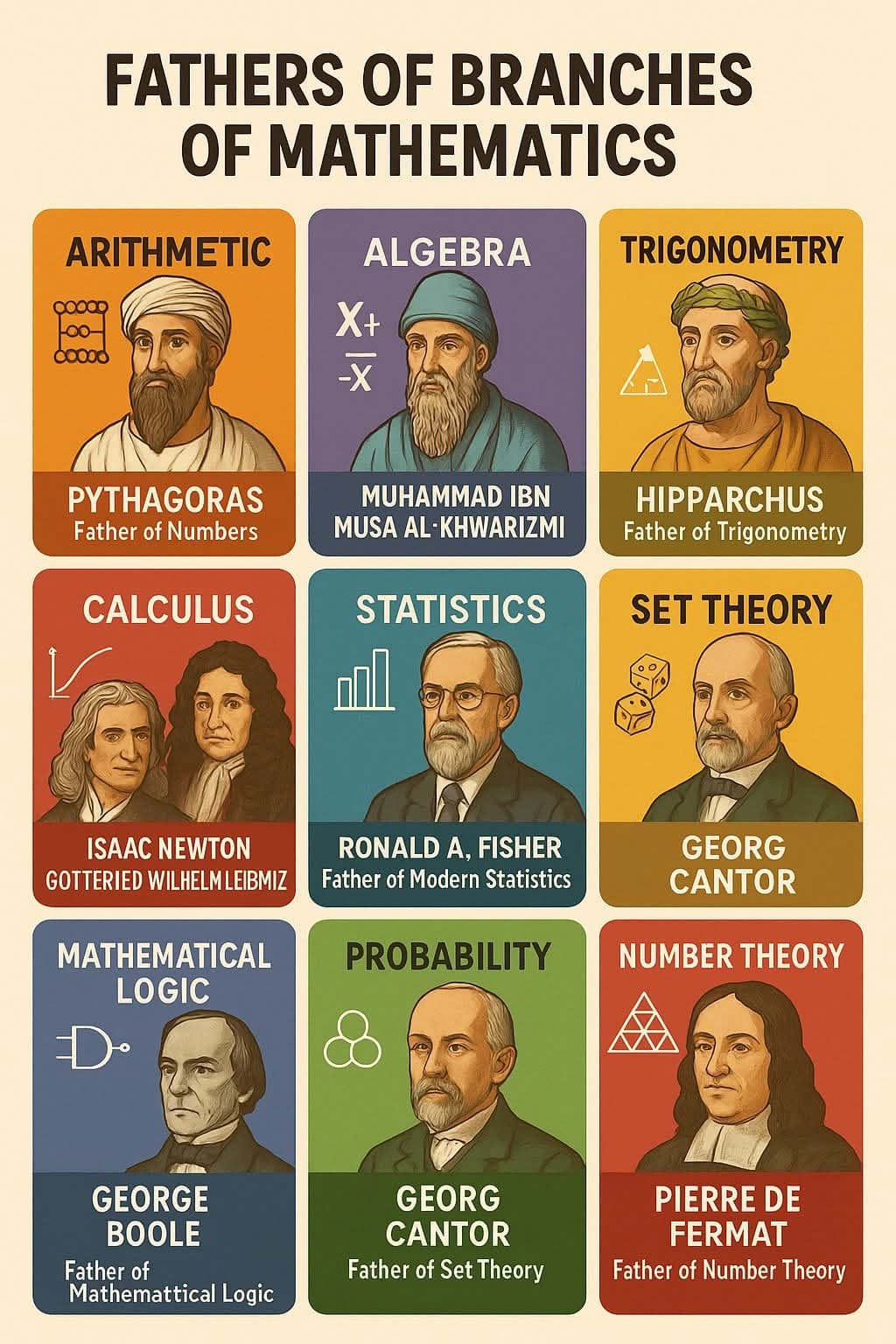
Pythagoras (Arithmetic):
Pythagoras was an ancient Greek mathematician and philosopher who founded a secretive religious and philosophical school in Croton, Italy. He is most famous for the Pythagorean theorem, which states that in a right-angled triangle, the square of the hypotenuse is equal to the sum of the squares of the other two sides. His school also made significant contributions to number theory, including the study of perfect and triangular numbers, and discovered the mathematical relationship between numbers and musical harmony.
Muhammad ibn Musa al-Khwarizmi (Algebra):
Muhammad ibn Musa al-Khwarizmi was a Persian mathematician, astronomer, and geographer who worked at the House of Wisdom in Baghdad during the Islamic Golden Age. He is known as the "Father of Algebra" because his book, Kitab al-Jabr wal-Muqabala (The Compendious Book on Calculation by Completion and Balancing), provided the first systematic solutions for linear and quadratic equations. The word "algebra" is derived from "al-jabr" in his book title, and the word "algorithm" is a Latinization of his name.
Hipparchus (Trigonometry):
Hipparchus was a Greek astronomer and mathematician who lived around 190–120 BCE. He is considered the founder of trigonometry, as he was the first to develop a table of chords (equivalent to a table of sines) for solving problems related to triangles, which was essential for his astronomical calculations. He also made highly accurate observations, including the discovery of the precession of the equinoxes and a precise calculation of the length of the year.
Isaac Newton & Gottfried Wilhelm Leibniz (Calculus):
Isaac Newton and Gottfried Wilhelm Leibniz are independently credited with developing infinitesimal calculus in the late 17th century. Newton's work, focused on "fluxions" and physical applications like gravity and motion, provided the groundwork for modern physics. Leibniz developed a more formal, algebraic approach with a superior notation system, which proved more adaptable for future mathematical advancements.
Ronald A. Fisher (Statistics):
Ronald A. Fisher was a British polymath who is considered the father of modern statistics. He made foundational contributions to experimental design, analysis of variance (ANOVA), and maximum likelihood estimation, which transformed the field of statistics into a rigorous scientific discipline. His work provided essential tools for research across many fields, including genetics and biology.
Georg Cantor (Set Theory & Probability):
Georg Cantor was a German mathematician who founded the theory of sets and introduced the concept of transfinite numbers, revolutionizing the understanding of infinity. He defined and differentiated between countable and uncountable sets and developed the theory of cardinal and ordinal numbers, despite significant criticism from some contemporaries. His ideas laid the foundation for much of modern mathematics.
George Boole (Mathematical Logic):
George Boole was an English mathematician and logician who created a new branch of mathematics now called Boolean algebra. His key work, An Investigation of the Laws of Thought, published in 1854, established symbolic logic, using a binary approach (true/false, yes/no) with operations like AND, OR, and NOT. This system provided the theoretical grounding for the design of modern digital computer circuits and the Information Age.
Pierre de Fermat (Number Theory):
Pierre de Fermat was a French lawyer and amateur mathematician who was a leading figure in 17th-century mathematics. He made significant contributions to number theory and, with Blaise Pascal, co-founded the theory of probability. He is most famous for his "Last Theorem," a conjecture that took over 350 years for mathematicians to prove. He also anticipated aspects of differential calculus with his method for finding maxima and minima of curves.